Preparing for Q4: Insurance Planning for Businesses
Q4 isn’t just about closing sales targets and finalising budgets. For many Singapore businesses, it’s also the most strategic window to review insurance portfolios. Decisions made now shape cost efficiency, compliance readiness, and employee confidence heading into the new year.
Done right, insurance planning in Q4 is less about renewals and more about aligning protection with business growth, workforce changes, and evolving risks.
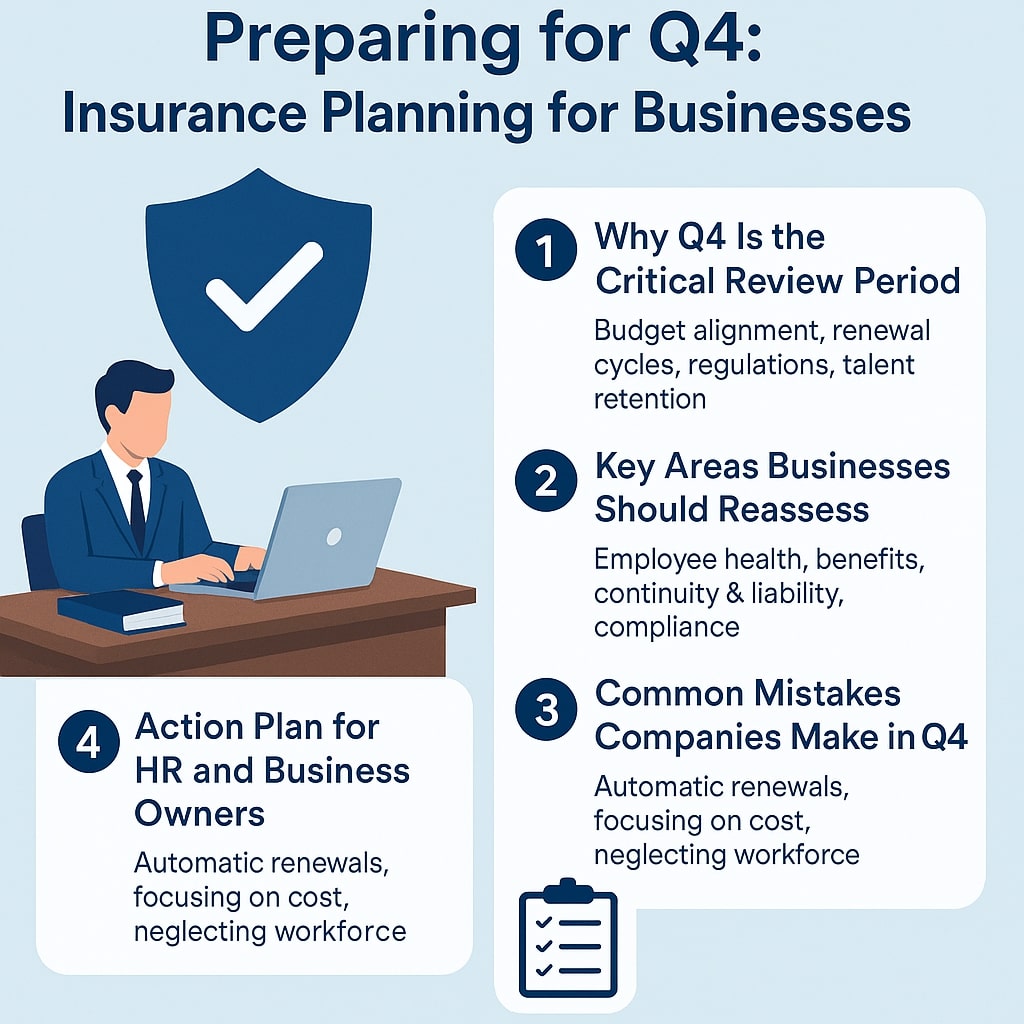
1. Why Q4 Is the Critical Review Period
Budget Alignment for Next Year
Most companies set 2026 budgets in Q4. Insurance is often one of the top three controllable HR and operating expenses, alongside payroll and IT. Early review helps finance teams avoid sudden spikes in premiums when renewals hit in January.Policy Renewal Cycles
Many corporate group health and liability policies renew at year-end. Reviewing claims experience and loss ratios early gives leverage to negotiate either reduced premiums or enhanced benefits.Regulatory & Market Changes
Employers must stay compliant with MOM’s Work Injury Compensation Act (WICA). At the same time, insurers adjust underwriting appetite annually — meaning businesses that shop early often lock in better terms before year-end repricing.Talent Retention in a Competitive Market
Benefits benchmarking reports consistently show healthcare and insurance as a top factor in attracting and retaining skilled staff, especially foreign professionals who lack MediShield Life coverage. Entering Q1 with an outdated benefits package risks losing top talent.
2. Key Areas Businesses Should Reassess
Employee Health & Benefits
Benchmark Coverage Adequacy: Compare inpatient and outpatient limits against MOH private hospital benchmarks. A $30,000 annual cap, once considered standard, may now be insufficient for a single major hospitalisation.
Medical History Disregarded (MHD): For SMEs crossing certain headcount thresholds, exploring MHD terms can eliminate exclusions for pre-existing conditions — a strong differentiator for talent attraction.
Dependent Coverage: Particularly critical for employers hiring mid- to senior-level expats. Extending coverage can increase loyalty and reduce family-related attrition.
Business Continuity & Liability
Professional Indemnity / D&O: If your business expanded services, opened overseas subsidiaries, or added board members this year, coverage must reflect those changes.
Cyber Insurance: The frequency of SME-targeted cyber incidents continues to rise. For many businesses, cyber liability is no longer optional but part of core risk management.
Business Interruption: Post-pandemic supply chain volatility highlighted the gaps in outdated BI coverage. Ensure current policies reflect your actual revenue streams and dependencies.
Work Injury & Compliance
WICA Coverage: Mandatory for all employees earning below the MOM threshold, but HR should also assess top-ups for higher earners and contractors who fall outside WICA.
Integration with Health Plans: Some insurers offer bundled WICA + medical schemes, which can streamline claims and reduce administrative cost.
3. Common Mistakes Companies Make in Q4
Renewing Without Data: HR teams often roll forward plans without reviewing claims data, leading to overpayment or undercoverage.
Chasing Lowest Premiums: Choosing the cheapest plan without analysing exclusions leads to costly “gaps in protection” later.
Ignoring Workforce Changes: Rapid hiring, foreign professionals, or dependent-heavy teams need different structures.
Failure to Communicate: Employees often undervalue benefits simply because they’re poorly explained. This reduces ROI on the employer’s investment.
4. Action Plan for HR and Business Owners
October
Collect claims reports, premium history, and current headcount data.
Identify employee demographics (expats, dependents, senior hires).
Benchmark coverage limits against MOH fee ranges and industry peers.
Identify benefit gaps (e.g. maternity, mental health, dependents).
November
Shortlist insurers with suitable SME or corporate solutions.
Engage insurers and brokers for proposals.
Negotiate renewals based on claims experience and market benchmarks.
Evaluate new risk areas (cyber, D&O, BI).
December
Finalise renewals and ensure compliance certificates (e.g. WICA).
Prepare employee communication campaigns for January.
Lock in budget alignment for FY2026.
Final Thoughts
For Singapore businesses, Q4 is the time to move beyond transactional renewals and treat insurance as a strategic lever. Strong, well-structured coverage does three things at once:
Protects against financial and compliance risks.
Enhances employee satisfaction and retention.
Positions the business competitively for the new year.
💡 Next Step: Review your current portfolio now. Benchmark against MOH ranges, assess alignment with your workforce, and identify policies that need upgrading. Small changes in Q4 can prevent big surprises in 2026.